Table of Contents
C# Features Quiz for Beginners – Test Your C# Knowledge
C# is one of the most popular programming languages used for building web applications, desktop software, cloud services, APIs, games, and enterprise applications. If you are learning C#, understanding its core features is essential before moving to advanced topics.
This C# Features Quiz is designed for beginners who want to test their knowledge of important C# programming concepts and language features. The quiz contains 25 multiple-choice questions covering key areas such as type safety, garbage collection, exception handling, object-oriented programming, delegates, properties, LINQ, and other important C# capabilities.
Whether you are a student, beginner programmer, B.Tech learner, or preparing for a technical interview, this quiz can help you revise C# fundamentals and identify areas where you need more practice.
What Is C#?
C# is a modern, object-oriented, type-safe programming language developed by Microsoft. It runs mainly on the .NET platform and is commonly used for application development.
C# combines the simplicity of high-level programming with powerful features such as automatic memory management, exception handling, object-oriented programming, generics, delegates, LINQ, and asynchronous programming.
Because of these features, C# is widely used in enterprise software, backend development, cloud applications, desktop software, and game development.
What You Will Learn in This C# Features Quiz
This beginner-level quiz focuses on the important features that make C# a powerful and flexible programming language.
1. Type Safety
C# is a strongly typed language. Variables, methods, and objects have specific data types, which helps reduce many common programming errors.
For example:
int age = 25;
string name = "Rahul";
Here, age stores an integer while name stores text.
Type safety improves code reliability and helps the compiler detect errors before the program runs.
2. Object-Oriented Programming
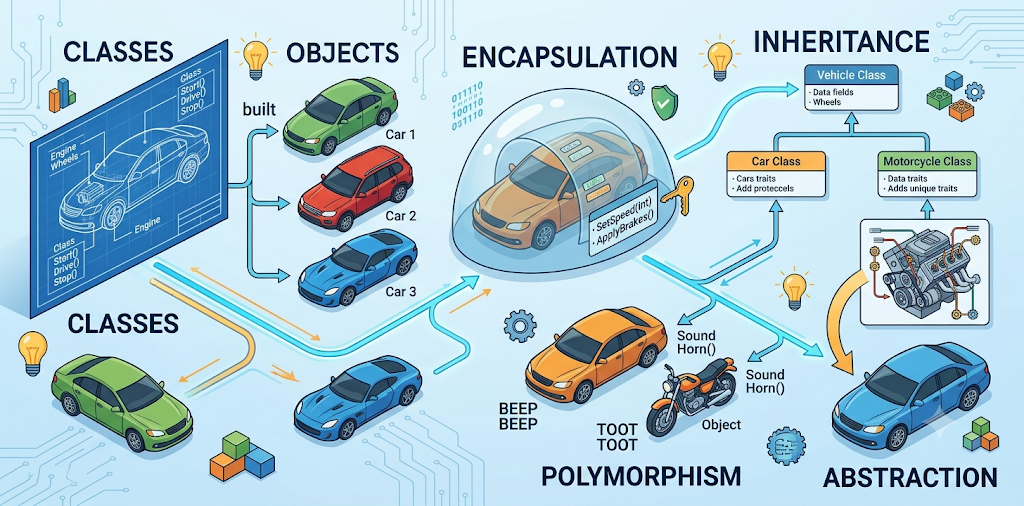
C# supports object-oriented programming principles such as:
- Classes
- Objects
- Encapsulation
- Inheritance
- Polymorphism
- Abstraction
These concepts help developers organize large applications into reusable and maintainable components.
3. Automatic Garbage Collection
C# uses automatic garbage collection to manage memory.
Developers usually do not need to manually release memory for objects. The .NET garbage collector automatically identifies unused objects and frees memory when required.
This helps reduce memory-related errors and simplifies application development.
4. Exception Handling
C# provides structured exception handling using keywords such as:
try
catch
finally
throw
Exception handling allows developers to manage runtime errors without causing the entire application to crash unexpectedly.
Example:
try
{
    int result = 10 / 0;
}
catch (Exception ex)
{
    Console.WriteLine(ex.Message);
}
5. Properties
Properties provide a controlled way to access private fields inside a class.
Example:
public class Student
{
    public string Name { get; set; }
}
Properties are widely used in C# because they improve encapsulation while keeping code simple.
6. Delegates
A delegate is a type that can store a reference to a method.
Delegates are commonly used for callbacks, event handling, and functional programming patterns.
Example:
delegate void MessageHandler(string message);Delegates are also the foundation of many event-driven features in C#.
7. Events
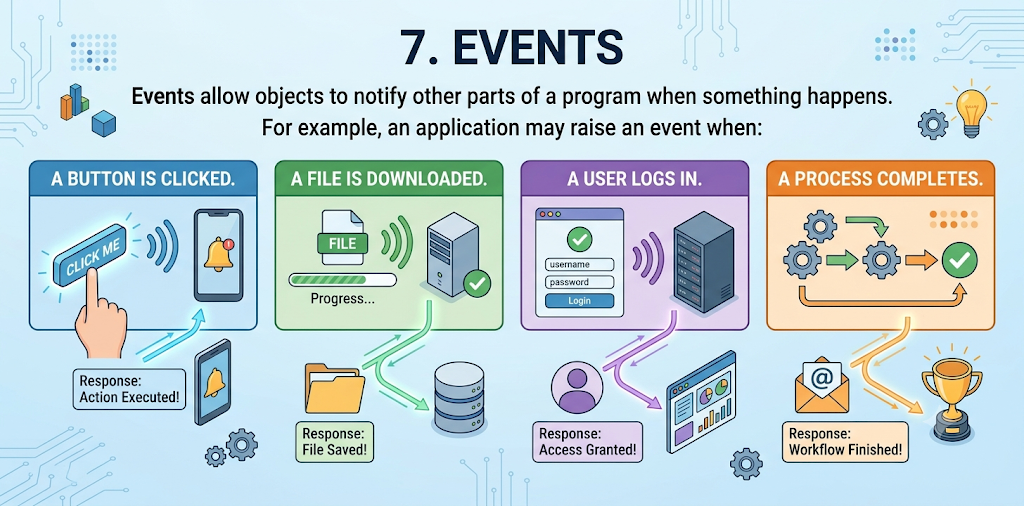
Events allow objects to notify other parts of a program when something happens.
For example, an application may raise an event when:
- A button is clicked
- A file is downloaded
- A user logs in
- A process completes
Events are commonly used in desktop applications, web applications, and event-driven programming.
8. LINQ
LINQ stands for Language Integrated Query.
It allows developers to query collections directly using C# syntax.
Example:
var numbers = new[] { 1, 2, 3, 4, 5 };

var evenNumbers = numbers.Where(n => n % 2 == 0);
LINQ makes it easier to filter, sort, group, and transform data.
9. Generics
Generics allow developers to create reusable classes and methods that can work with different data types.
Example:
List<int> numbers = new List<int>();

List<string> names = new List<string>();
The same List<T> structure can work with integers, strings, objects, and many other types.
10. Cross-Platform Development
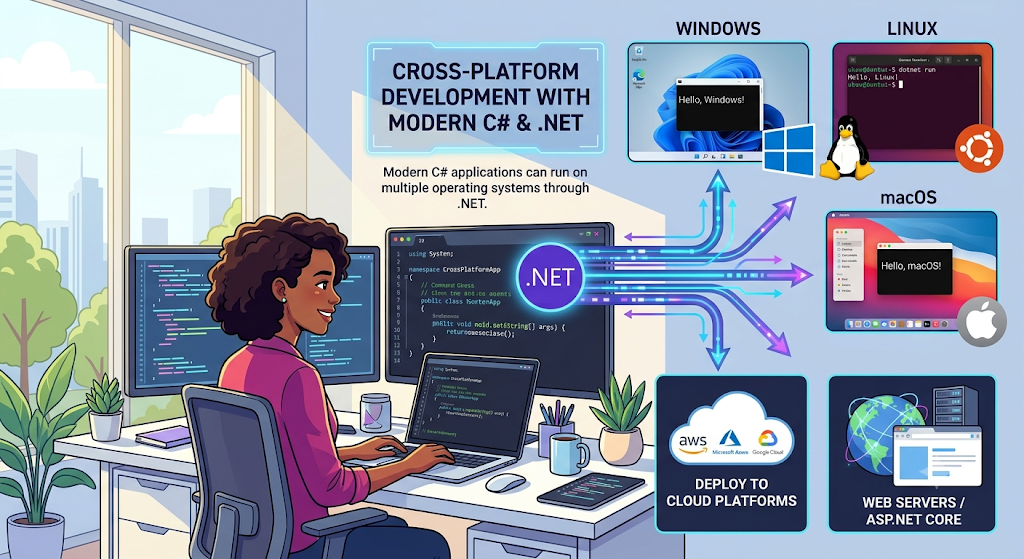
Modern C# applications can run on multiple operating systems through .NET.
Developers can build applications for:
- Windows
- Linux
- macOS
- Cloud platforms
- Web servers
This makes C# useful for modern cross-platform application development.
Who Should Take This C# Quiz?
This C# quiz for beginners is useful for:
- Students learning C#
- B.Tech and diploma students
- Beginners learning .NET
- Developers preparing for interviews
- Students preparing for programming exams
- Anyone revising basic C# concepts
You do not need advanced programming knowledge to attempt this quiz.
C# Features Covered in the Quiz
The 25 questions may test your understanding of topics such as:
- C# type safety
- Object-oriented programming
- Classes and objects
- Garbage collection
- Exception handling
- Properties
- Delegates
- Events
- Generics
- LINQ
- Interfaces
- Constructors
- Method overloading
- Memory management
- .NET support
- Cross-platform development
Try to answer every question before checking your score.
Why Practice C# MCQ Questions?
Reading theory is important, but quizzes help you check whether you actually remember and understand the concepts.
Practicing C# MCQ questions can help you:
- Improve concept recall
- Find weak topics
- Prepare for technical interviews
- Revise faster before exams
- Strengthen programming fundamentals
- Become more confident with C#
If you answer a question incorrectly, review that concept before attempting the quiz again.
Start the C# Features Quiz
Now test your knowledge with the C# Features Quiz for Beginners.
The quiz contains:
25 Questions
Beginner Level
Multiple Choice Questions
C# Fundamentals and Features
C# Features Quiz
Test your knowledge of important C# features with 25 beginner-friendly multiple-choice questions.
Try to complete all questions without searching for the answers. After finishing, review the questions you answered incorrectly and study those topics again.
How to Prepare for the C# Features Quiz
Before taking the quiz, revise these areas:
- Basic C# syntax and data types
- Classes and objects
- OOP principles
- Exception handling
- Garbage collection
- Properties and methods
- Delegates and events
- Generics
- LINQ basics
- .NET and cross-platform support
You do not need to memorize every definition. Focus on understanding what each feature does and why developers use it.
Frequently Asked Questions
Is this C# Features Quiz suitable for beginners?
Yes. This quiz is designed for beginners and focuses mainly on fundamental C# features and concepts.
How many questions are included in the quiz?
The quiz contains 25 multiple-choice questions.
Is this quiz useful for C# interview preparation?
Yes. Many beginner-level C# interviews include questions about type safety, object-oriented programming, delegates, garbage collection, exception handling, and other basic features.
Do I need .NET knowledge before taking this quiz?
Basic knowledge of the relationship between C# and .NET is helpful, but advanced .NET knowledge is not required.
Can I take the quiz more than once?
Yes. Retaking the quiz is a useful way to improve your score and reinforce concepts you previously answered incorrectly.
Conclusion
C# offers many powerful features that make application development safer, easier, and more productive. Understanding concepts such as type safety, object-oriented programming, garbage collection, delegates, exception handling, generics, and LINQ provides a strong foundation for learning advanced C# and .NET development.
Take the C# Features Quiz, check your score, review your mistakes, and try again until you are comfortable with every topic.
Learn C# from Microsoft
Want to learn more after completing the quiz? Explore the official Microsoft C# documentation for tutorials, fundamentals, language concepts, code examples, and reference guides.